Originally published here
In an unprecedented show of democratic openness, Súmate is proposing to organize the primaries to find the candidate that will represent the opposition in the forthcoming Presidential elections.
Maria Corina Machado and Ricardo Estévez exposed the rules and the logistics envisioned by Súmate to choose the candidate.
I hope that the CNE and the “Aquelarre” of government officials read them so that they can understand what an OPEN, CLEAN, FAIR and DEMOCRATIC process really means.
The presentation in Power Point can be downloaded from Sumate main page.
Here is the main proposal for the election:
1.- All those registered in the REP as of March 2006 can vote in the Primaries
2.- The elected candidate will be the winner by simple majority
3.- The voting will be MANUAL and the scrutiny will be PUBLIC
4.- All the physical logs will be destroyed.
5.- The whole country will be covered with 3000 centers
Note that Súmate is proposing the destruction of the log material to avoid any type of blacklisting like what happened with the signers of the Revocatory Referendum.
Here is the schedule:
REGISTRATION OF CANDIDATES: MAY 8 TO MAY 15, 2006.
CAMPAIGN: MAY 21st to JULY 14, 2006
PRIMARIES: JULY 16, 2006
REGISTRATION TO THE CNE: AUGUST 5 to AUGUST 28, 2006
Súmate is also asking for volunteers for the organization. If you are interested, here are the telephone number and the email:
(0212) 715.28.15
voluntarios at sumate.org
So now, we all know what was the “Aquelarre” Willian Lara was talking about! Súmate was preparing a demonstration of democracy in action, that the government officials are not even able to understand.
Reporting from cyberspace,
Jorge Arena
Democratic Venezuelan and Distinguished Ghost.
Wednesday, April 19, 2006

Monday, April 17, 2006
Willian Lara and Súmate's "Aquelarre"
Originally published here by Jorge Arena
Everytime I see the MINCI home page without any picture of Chávez, I get nervous. I cannot help but wonder what the heavy government weights must be concocting when Yo El Supremo is not in their front page. The explanation might be very simple, the President might be resting for a few days, but, noneless, I always wonder what is going on, in particular when neither the Vice President nor Nicolas Maduro appear in their pages.
My ghost experience has taught me that nothing is irrelevant in the Chavista kingdom of Venezuela.
However, I was relieved to see that at least William Lara, the new Minister of Information was there today, in prime space. This time, the object of his speech was Súmate. He accused the organization of starting the “mediatic machine gun” against the committee that is selecting the new members of the CNE. The article specifically says:
“invitó a venezolanos y venezolanas que se oponen al proceso de cambio democrático liderado por el presidente Chávez que no hagan oídos a este aquelarre montado por Súmate, que probablemente tendrá eco mañana en otros portavoces de la política de Bush, y que se mantengan leales a sus convicciones y prácticas democráticas”.
“Invited Venezuelans that oppose the process of democratic change led by President Chávez not to pay attention to the coven that Súmate is putting into place and that will surely have an echo tomorrow in other spokepersons of Bush’s politics and be [the Venezuelans that oppose..] loyal to their convictions and democratic practices..”
So this Venezuelan and curious blogger was pretty curious about what this “aquelarre” was all about. I looked it up first in the Real Academia and found the following definition:
1. m. Junta o reunión nocturna de brujos y brujas, con la supuesta intervención del demonio ordinariamente en figura de macho cabrío, para la práctica de las artes de esta superstición.
So it seems that the aquelarre is a night meeting of witches with the Devil’s intervention….
So what triggered Minister Lara to use such a charming term against Súmate?
Well, the commission in charge of electing the new CNE is about to provide the definite list in a week or two and the rumors around the National Assembly say that three of the current officials will be re-elected: Oscar Battaglini, Tibisay Lucena and Oscar León. Súmate has objected their names because they say that those individuals did not provide an account of their management or the balance of their budget during the years as CNE officials.
Now, this ghost blogger disagrees for the first time this year with Súmate. They are absolutely, totally wrong to be objecting the term of these three officials based on some trifle like lack of transparency and of accountability! I take advantage of this ghost post to make a formal complaint against Súmate’s objections of those candidates.
In fact, this ghost blogger strongly objects the candidacy of those CNE officials as well, but not because of the mild reasons provided by Súmate, but because of their potential responsibility in handing to the government the personal data of millions of Venezuelans that led to the Tascón list, the Maisanta database and the Batalla de Santa Inés software that has created a political apartheid in Venezuela.
I want these guys to be investigated first. Did they approve the handling of the personal data to the Maisanta campaign? Did they know that the data was being used by Tascón in a public web page? Did they know that the Maisanta command had elaborated a database and a program to be used for political profiling and blacklisting of Venezuelan citizens? Did they protest when they knew of the use of the data? Did they order an internal investigation? Did they realize that the rights of millions of Venezuelans were being violated?
I want to get the answers to those questions first before these guys ever get to be nominated again for the CNE, Mr. Lara. So thank you very much for reminding me that I should be loyal to my democratic convictions. I agree with you, Súmate is wrong this time, but because they are being way too mild.
And, BTW, dear Minister, many thanks also for helping me improve my Spanish vocabulary. I now have a new precise word to ask you the following…
What type of Aquelarre are all the President’s man putting in place these days?
Reporting from Cyberspace,
Jorge Arena
The Devil’s Distinguished Ghost.
Everytime I see the MINCI home page without any picture of Chávez, I get nervous. I cannot help but wonder what the heavy government weights must be concocting when Yo El Supremo is not in their front page. The explanation might be very simple, the President might be resting for a few days, but, noneless, I always wonder what is going on, in particular when neither the Vice President nor Nicolas Maduro appear in their pages.
My ghost experience has taught me that nothing is irrelevant in the Chavista kingdom of Venezuela.
However, I was relieved to see that at least William Lara, the new Minister of Information was there today, in prime space. This time, the object of his speech was Súmate. He accused the organization of starting the “mediatic machine gun” against the committee that is selecting the new members of the CNE. The article specifically says:
“invitó a venezolanos y venezolanas que se oponen al proceso de cambio democrático liderado por el presidente Chávez que no hagan oídos a este aquelarre montado por Súmate, que probablemente tendrá eco mañana en otros portavoces de la política de Bush, y que se mantengan leales a sus convicciones y prácticas democráticas”.
“Invited Venezuelans that oppose the process of democratic change led by President Chávez not to pay attention to the coven that Súmate is putting into place and that will surely have an echo tomorrow in other spokepersons of Bush’s politics and be [the Venezuelans that oppose..] loyal to their convictions and democratic practices..”
So this Venezuelan and curious blogger was pretty curious about what this “aquelarre” was all about. I looked it up first in the Real Academia and found the following definition:
1. m. Junta o reunión nocturna de brujos y brujas, con la supuesta intervención del demonio ordinariamente en figura de macho cabrío, para la práctica de las artes de esta superstición.
So it seems that the aquelarre is a night meeting of witches with the Devil’s intervention….
So what triggered Minister Lara to use such a charming term against Súmate?
Well, the commission in charge of electing the new CNE is about to provide the definite list in a week or two and the rumors around the National Assembly say that three of the current officials will be re-elected: Oscar Battaglini, Tibisay Lucena and Oscar León. Súmate has objected their names because they say that those individuals did not provide an account of their management or the balance of their budget during the years as CNE officials.
Now, this ghost blogger disagrees for the first time this year with Súmate. They are absolutely, totally wrong to be objecting the term of these three officials based on some trifle like lack of transparency and of accountability! I take advantage of this ghost post to make a formal complaint against Súmate’s objections of those candidates.
In fact, this ghost blogger strongly objects the candidacy of those CNE officials as well, but not because of the mild reasons provided by Súmate, but because of their potential responsibility in handing to the government the personal data of millions of Venezuelans that led to the Tascón list, the Maisanta database and the Batalla de Santa Inés software that has created a political apartheid in Venezuela.
I want these guys to be investigated first. Did they approve the handling of the personal data to the Maisanta campaign? Did they know that the data was being used by Tascón in a public web page? Did they know that the Maisanta command had elaborated a database and a program to be used for political profiling and blacklisting of Venezuelan citizens? Did they protest when they knew of the use of the data? Did they order an internal investigation? Did they realize that the rights of millions of Venezuelans were being violated?
I want to get the answers to those questions first before these guys ever get to be nominated again for the CNE, Mr. Lara. So thank you very much for reminding me that I should be loyal to my democratic convictions. I agree with you, Súmate is wrong this time, but because they are being way too mild.
And, BTW, dear Minister, many thanks also for helping me improve my Spanish vocabulary. I now have a new precise word to ask you the following…
What type of Aquelarre are all the President’s man putting in place these days?
Reporting from Cyberspace,
Jorge Arena
The Devil’s Distinguished Ghost.
Saturday, February 11, 2006
A glimpse into the Sumate trial
Originally published here by Miguel Octavio
(Condensed from ZETA 2/10/2006, trial session on 2/07/2006)
-Judge hears the name of defense lawyer of Luis Palacios and orders him to leave the room (Lawyer had recused him)
-Judge opens session and says the trial is beginning, says nothing about three recusations against him.
-Defense lawyer asks to speak and insists, judge also has him removed from room.
-Accused are left without defense lawyers at this stage, obviously illegal.
-Alejandro Plaz' father, a former Justice of the Supreme Court, gets up says this is a nazi trial, he is also kicked out.
-Juan Martin Echevarria Sr., father of one of the defense lawyers kicked out, addresses the prosecutor, arguing the trial can't start under this conditions.
-Judge ignores argumens, refuses to consider recusations, trial begins.
-Prosecutor asks that the accused be tried in prison.
-Judge goes to the bathroom upon his return (who did he go and consult?) says that trial will resume next Tuesday.
-One of the international observers said as he was going out: "If someone told me this happened, I would not believe it"
(Condensed from ZETA 2/10/2006, trial session on 2/07/2006)
-Judge hears the name of defense lawyer of Luis Palacios and orders him to leave the room (Lawyer had recused him)
-Judge opens session and says the trial is beginning, says nothing about three recusations against him.
-Defense lawyer asks to speak and insists, judge also has him removed from room.
-Accused are left without defense lawyers at this stage, obviously illegal.
-Alejandro Plaz' father, a former Justice of the Supreme Court, gets up says this is a nazi trial, he is also kicked out.
-Juan Martin Echevarria Sr., father of one of the defense lawyers kicked out, addresses the prosecutor, arguing the trial can't start under this conditions.
-Judge ignores argumens, refuses to consider recusations, trial begins.
-Prosecutor asks that the accused be tried in prison.
-Judge goes to the bathroom upon his return (who did he go and consult?) says that trial will resume next Tuesday.
-One of the international observers said as he was going out: "If someone told me this happened, I would not believe it"
Friday, February 10, 2006
The beat goes on for revolutionary Justice in both the Sumate and Tal Cual cases
Originally published here by Miguel Octavio
So, after six failed appeals, the Sixth Appeals Court voids all of the decisions in the case where Sumate is being accused of conspiracy. The reason? That the judge was not using a jury in the case, a decision he made himself in violation of the law. The law says in a case like this the judge has to use at least two jurors and only with the authorization of a higher Court can the trial proceed without jurors. The other six Courts knew the law was being violated but did nothing, for some reason this one did. Now, before you get excited about it, all this really means is that the whole thing is reset and the trial starts again as if the two previous procedures had never taken place..
Then, a couple of hours later the Prosecutor calls the Sumate Board on a new case against them, in which they will also be charged as they are being called to testify as an accused party.. What is it this time around? They are being accused of electoral crimes for abrogating on themslves the representation of the people when they collected the petition in 2003 before there were regulations. Thus, they are basically being investigated because they supposedly had no right to gather or submit signatures requesting a recall referendum. It will be interesting, if I recall correctly, the Supreme Court bypassed the Electoral Hall of that Court on a case related to the referendum once arguing that a referendum was not an "electoral" process. I guess gathering the signatures is even more remote than that, but they simply don't care. The Court can reverse itslef if it suits them.
But the beats go on in the Venezuelan Justice system, as Tal Cual reports that the case files against that newspaper, in which the paper is being prosecuted twice for the same crime, have not been made available to the lawyers of the paper in violation of the law. What else is new?
So, after six failed appeals, the Sixth Appeals Court voids all of the decisions in the case where Sumate is being accused of conspiracy. The reason? That the judge was not using a jury in the case, a decision he made himself in violation of the law. The law says in a case like this the judge has to use at least two jurors and only with the authorization of a higher Court can the trial proceed without jurors. The other six Courts knew the law was being violated but did nothing, for some reason this one did. Now, before you get excited about it, all this really means is that the whole thing is reset and the trial starts again as if the two previous procedures had never taken place..
Then, a couple of hours later the Prosecutor calls the Sumate Board on a new case against them, in which they will also be charged as they are being called to testify as an accused party.. What is it this time around? They are being accused of electoral crimes for abrogating on themslves the representation of the people when they collected the petition in 2003 before there were regulations. Thus, they are basically being investigated because they supposedly had no right to gather or submit signatures requesting a recall referendum. It will be interesting, if I recall correctly, the Supreme Court bypassed the Electoral Hall of that Court on a case related to the referendum once arguing that a referendum was not an "electoral" process. I guess gathering the signatures is even more remote than that, but they simply don't care. The Court can reverse itslef if it suits them.
But the beats go on in the Venezuelan Justice system, as Tal Cual reports that the case files against that newspaper, in which the paper is being prosecuted twice for the same crime, have not been made available to the lawyers of the paper in violation of the law. What else is new?
Thursday, February 09, 2006
Sumate under fire Editorial in El Nacional
Translation published here by Miguel Octavio.
Sumate under fire. El Nacional.
The official persecution of the directors of the civil ONG Sumate is reaching its end.
They are accused of conspiring "to alter the Republican order", as if they had tried to implant a monarchy in Venezuela, no more, no less. As if armed with machine guns, rockets, tanks and bombers, they had placed in danger the soundness and continuity of the supposed Bolivarian revolution.
The Government demonstrates with this that is it is not prepared to accept the smallest discrepancies, not the least dissidence, or the most discreet request that the 2006 elections be presided by a National Electoral Council (CNE) that can be trusted. That is what Sumate always asked for, interpreting the large majority of Venezuelans, nothing different, even, to what has been requested by international organizations such as the OAS. Nothing different from the observations made by the hemispheric organization in its report about the elections of December 4th.
There are a few ways to read the trial against Sumate. One of them is the intransigence and the intolerance of the regime. Another one, the wish of taking advantage of the punishment against the directors so that everybody learns the lesson and the requests for more transparent and fair conditions for all citizens cease.
That people shut up out of fear.
The Electoral year projects itself as a year of persecutions and threats, while the officialist train moves at high speed towards December 3d. As dangerous conspirators, the Prosecutor asked the 7th. Court that Maria Corina Machado and Alejandro Plaz be tried separately, since others accused, Luis Enrique Palacios and Ricardo Esteves, are being accused of "complicity". But, on top of that, as conspirators of great danger, they should be tried behind bars. No wonder the defense lawyers warn that at the next hearing both Machado as well as Plaz could be jailed.
The defense has denounced a number of irregularities along the process. The accused were not allowed to speak.
The representative from the Prosecutor's office reiterated the request that they be tried in prison, despite the decision by the Supreme Court that forbids it. Thus, not even these formalitities are taken into consideration.
When lawyer Juan Martin Echeverria jr. insisted on speaking, the judge ordered the constables to remove him from the room. If one wants to have an idea how the trial is being carried out, this detail is sufficient. You can guess what the outcome will be.
As stated above, Machado and Plaz are being accused of the crime of conspiracy to "destroy the form of republican politics that the nation has been given" Among the crimes they have been charged with is receiving money from the organization National Endowment for Democracy of the United States. Palacios and Estevez face the same process for the same crime, but as accomplices.
The Prosecutor Ortega Diaz requested the maximum penalty for the crime of conspiracy, 16 years.
This rigor has no precedent in a country where military conspirators (like our President) were judged only by military judges, never suffered sentences of that magnitude and always ended being benefited from measures of pardon. Even in bloody occasions (like February 4th. 1992) in which the uprisings left hundreds of dead. Now that the coup plotters from the Saman de Guere are in power, they see with horror the specter of subversion. They see conspirators even in organizations like Sumate. But the civilians never threatened anyone.
Sumate has acted openly, has accounted for its income and expenses. To say that the meetings of Sumate did not have as their objective electoral training of the citizens but a subversive end, that of overthrowing the Bolivarian regime, is a valid argument only for idiots. One would have to give the Sumate Board an award for those "conspirators" that respect the law: they would be an exception in the history of Venezuela.
And it is this almighty regime, where the military predominates, the most armed, the one that has had the largest resources, the one that feels threatened. It is like one of those tales of Antonio Arraiz where tio Conejo (Uncle Rabbit) makes tio Tigre (Uncle Tiger) run. Unfortunately the question can not be one for being festive, because what is in danger is the freedom of some citizens worthy of esteem that have believed in the perfectibility of our institutions and have advocated for that. You can not condemn them with coarse lies.
Let's defend now justice and let us all reject this absurd trial.
Sumate under fire. El Nacional.

The official persecution of the directors of the civil ONG Sumate is reaching its end.
They are accused of conspiring "to alter the Republican order", as if they had tried to implant a monarchy in Venezuela, no more, no less. As if armed with machine guns, rockets, tanks and bombers, they had placed in danger the soundness and continuity of the supposed Bolivarian revolution.
The Government demonstrates with this that is it is not prepared to accept the smallest discrepancies, not the least dissidence, or the most discreet request that the 2006 elections be presided by a National Electoral Council (CNE) that can be trusted. That is what Sumate always asked for, interpreting the large majority of Venezuelans, nothing different, even, to what has been requested by international organizations such as the OAS. Nothing different from the observations made by the hemispheric organization in its report about the elections of December 4th.
There are a few ways to read the trial against Sumate. One of them is the intransigence and the intolerance of the regime. Another one, the wish of taking advantage of the punishment against the directors so that everybody learns the lesson and the requests for more transparent and fair conditions for all citizens cease.
That people shut up out of fear.
The Electoral year projects itself as a year of persecutions and threats, while the officialist train moves at high speed towards December 3d. As dangerous conspirators, the Prosecutor asked the 7th. Court that Maria Corina Machado and Alejandro Plaz be tried separately, since others accused, Luis Enrique Palacios and Ricardo Esteves, are being accused of "complicity". But, on top of that, as conspirators of great danger, they should be tried behind bars. No wonder the defense lawyers warn that at the next hearing both Machado as well as Plaz could be jailed.
The defense has denounced a number of irregularities along the process. The accused were not allowed to speak.
The representative from the Prosecutor's office reiterated the request that they be tried in prison, despite the decision by the Supreme Court that forbids it. Thus, not even these formalitities are taken into consideration.
When lawyer Juan Martin Echeverria jr. insisted on speaking, the judge ordered the constables to remove him from the room. If one wants to have an idea how the trial is being carried out, this detail is sufficient. You can guess what the outcome will be.
As stated above, Machado and Plaz are being accused of the crime of conspiracy to "destroy the form of republican politics that the nation has been given" Among the crimes they have been charged with is receiving money from the organization National Endowment for Democracy of the United States. Palacios and Estevez face the same process for the same crime, but as accomplices.
The Prosecutor Ortega Diaz requested the maximum penalty for the crime of conspiracy, 16 years.
This rigor has no precedent in a country where military conspirators (like our President) were judged only by military judges, never suffered sentences of that magnitude and always ended being benefited from measures of pardon. Even in bloody occasions (like February 4th. 1992) in which the uprisings left hundreds of dead. Now that the coup plotters from the Saman de Guere are in power, they see with horror the specter of subversion. They see conspirators even in organizations like Sumate. But the civilians never threatened anyone.
Sumate has acted openly, has accounted for its income and expenses. To say that the meetings of Sumate did not have as their objective electoral training of the citizens but a subversive end, that of overthrowing the Bolivarian regime, is a valid argument only for idiots. One would have to give the Sumate Board an award for those "conspirators" that respect the law: they would be an exception in the history of Venezuela.
And it is this almighty regime, where the military predominates, the most armed, the one that has had the largest resources, the one that feels threatened. It is like one of those tales of Antonio Arraiz where tio Conejo (Uncle Rabbit) makes tio Tigre (Uncle Tiger) run. Unfortunately the question can not be one for being festive, because what is in danger is the freedom of some citizens worthy of esteem that have believed in the perfectibility of our institutions and have advocated for that. You can not condemn them with coarse lies.
Let's defend now justice and let us all reject this absurd trial.
Wednesday, February 08, 2006
More (In) Justice from the Revolution
Originally published here by Miguel Octavio
So, on the same day that Teodoro Petkoff received a second notification of a process being opened against him and his newspaper (same case, two processes!), the Prosecutor General asked for up to 16 years of jail for the leaders of Sumate Maria Corina Machado and Alejandro Plaz, for the crime of receiving $30,000 for electoral education from a foreign source, in this case the bipartisan US Foundation, the National Endowment for Democracy.
Curiously, Chavez and his cronies were found innocent of violating any laws in the case of the proven donation of US$ 1.5 million by Spanish bank BBVA to Chavez’ Presidential campaign. And in another case of Bolivarian justice, the Government plans to build a monument to honor the infamous shooters of Puente El LLaguno, who, of course, were declared innocent.
I guess these judges when they drink in private sing in harmony with the President of the Supreme Court “Uh Ah Chavez no se va”. Some (In)Justice!
So, on the same day that Teodoro Petkoff received a second notification of a process being opened against him and his newspaper (same case, two processes!), the Prosecutor General asked for up to 16 years of jail for the leaders of Sumate Maria Corina Machado and Alejandro Plaz, for the crime of receiving $30,000 for electoral education from a foreign source, in this case the bipartisan US Foundation, the National Endowment for Democracy.

Curiously, Chavez and his cronies were found innocent of violating any laws in the case of the proven donation of US$ 1.5 million by Spanish bank BBVA to Chavez’ Presidential campaign. And in another case of Bolivarian justice, the Government plans to build a monument to honor the infamous shooters of Puente El LLaguno, who, of course, were declared innocent.
I guess these judges when they drink in private sing in harmony with the President of the Supreme Court “Uh Ah Chavez no se va”. Some (In)Justice!
Saturday, November 19, 2005
Thursday, November 17, 2005
Sumate blasts the Electoral Board: Is anybody listening?
Originally published here by Miguel Octavio
For the past few days Sumate has been blasting the Electoral Board, but it appears as if the whole country has been anesthetized into a stupor as nobody seems to care, either within the political parties or the voters. Essentially, Sumate has found numerous violations of the Electoral Laws of Venezuela, none of which can be explained as simple mistakes, omissions or misinterpretations. In fact, most of them suggest to anyone with any ability to reason, a concerted effort to deceive, manipulate and control the election. While there was some progress yesterday, as the OAS met with the CNE and attempted to convince the Electoral Board to a) count more of the ballots and b) allow political parties to have access to the Electoral Registry, conditions are still iffy as best as Sumate has shown.
Sumate’s criticism is centered on the following issues:
Counting the Ballots: Article 172 of Venezuela’s Suffrage law says that even if electronic means are used in the voting process, all ballots have to be counted manually and their number compared to the total number indicated by the voting machines. According to this all ballot boxes should be opened, their number counted and totals compared. According to the same law, if this total is not in agreement, the votes from that machine are simply not valid. None of these steps were followed in the 2004 recall vote, regional elections in October 2004, and regional elections in August 2005 or is being planned for the upcoming Assembly elections in December. Do I hear Rule of Law from any of my readers?
Now, the law is obviously screwy, but it is the law. This is part of the problem with the autocratic style of this Government, just because the law says you have to count the ballots without reading them, which is non-sensical; it does not mean it should not be done. In fact, do it and once you are there, read the pieces of papers and give the whole process more transparency to do it! Instead, international observers are negotiating to increase the ballots that would be “audited” (not tallied, audited) and the Electoral Board in a magnanimous offer is willing to consider increasing the “audit” from 32% to 47% of all boxes. And we are expected to be grateful!
The Audit: On top of the above, the “audit” that is being planned has been suddenly changed. In the August regional elections, ballot boxes were opened and on the same tally sheet printed by the electronic machines, the manual count was inserted. This time around, the regulations which were approved last week, instead of the six months established by law, say that the tally sheet printed by the machine will be put in an envelope before the manual count begins. The manual count will then proceed and will be written on a separate sheet, put in a different envelope and sent to the CNE, which will have five weeks to compare the results! Yeah, sure, the CNE itself will do the audit and tell us what happened. That looks more like a secret audit and certainly makes no sense.
Electoral Registry: No Electoral Registry was handed over to the political parties as required by law six months before the election. Then, it was handed over a month ago and it has many errors. I already reported on the amazing Gonzalez family of Zulia state, which had 2002 people with that last name born on the same day in 1974. Moreover, many of them only had one last name, illegal according to the law. The President of the CNE dismissed this as “errors” common in all electoral registries in the world which typically have 5% of errors. And we are supposed to believe it
But Sumate has expressed other concerns. There are for example, the “immortals”, those Venezuelans who are one hundred years of older and are still in the electoral registry. They happen to be over 0.1% of the population, outside of actuarial ranges as shown below

Besides this remarkable number of very old people, which should call for a team of experts from the WHO to come and study them, there is the peculiar person born in the XVIII th. Century which should be the subject of investigation on his/her own.
Besides this, there is the growth in the number of people registered to vote as well as migrated from one municipality to the other as seen in the table below:

The number of new voters increased between August 03 and October 05 by 18.3% (and has reached 20% at the time of this writing). The Government explains this by saying that this is the result of a program to include people in the electoral process, however, the “inclusion” is highly non-uniform concentrating in the border states and Caracas. At the same time 21.8% of the voters have moved since August 2003, 13.9% since the recall vote which is quite surprising more so when you find out that an inordinate proportion compared to historical patterns is to a different state (20%) or a different electoral circuit (10%).
For the past few days Sumate has been blasting the Electoral Board, but it appears as if the whole country has been anesthetized into a stupor as nobody seems to care, either within the political parties or the voters. Essentially, Sumate has found numerous violations of the Electoral Laws of Venezuela, none of which can be explained as simple mistakes, omissions or misinterpretations. In fact, most of them suggest to anyone with any ability to reason, a concerted effort to deceive, manipulate and control the election. While there was some progress yesterday, as the OAS met with the CNE and attempted to convince the Electoral Board to a) count more of the ballots and b) allow political parties to have access to the Electoral Registry, conditions are still iffy as best as Sumate has shown.
Sumate’s criticism is centered on the following issues:
Counting the Ballots: Article 172 of Venezuela’s Suffrage law says that even if electronic means are used in the voting process, all ballots have to be counted manually and their number compared to the total number indicated by the voting machines. According to this all ballot boxes should be opened, their number counted and totals compared. According to the same law, if this total is not in agreement, the votes from that machine are simply not valid. None of these steps were followed in the 2004 recall vote, regional elections in October 2004, and regional elections in August 2005 or is being planned for the upcoming Assembly elections in December. Do I hear Rule of Law from any of my readers?
Now, the law is obviously screwy, but it is the law. This is part of the problem with the autocratic style of this Government, just because the law says you have to count the ballots without reading them, which is non-sensical; it does not mean it should not be done. In fact, do it and once you are there, read the pieces of papers and give the whole process more transparency to do it! Instead, international observers are negotiating to increase the ballots that would be “audited” (not tallied, audited) and the Electoral Board in a magnanimous offer is willing to consider increasing the “audit” from 32% to 47% of all boxes. And we are expected to be grateful!
The Audit: On top of the above, the “audit” that is being planned has been suddenly changed. In the August regional elections, ballot boxes were opened and on the same tally sheet printed by the electronic machines, the manual count was inserted. This time around, the regulations which were approved last week, instead of the six months established by law, say that the tally sheet printed by the machine will be put in an envelope before the manual count begins. The manual count will then proceed and will be written on a separate sheet, put in a different envelope and sent to the CNE, which will have five weeks to compare the results! Yeah, sure, the CNE itself will do the audit and tell us what happened. That looks more like a secret audit and certainly makes no sense.
Electoral Registry: No Electoral Registry was handed over to the political parties as required by law six months before the election. Then, it was handed over a month ago and it has many errors. I already reported on the amazing Gonzalez family of Zulia state, which had 2002 people with that last name born on the same day in 1974. Moreover, many of them only had one last name, illegal according to the law. The President of the CNE dismissed this as “errors” common in all electoral registries in the world which typically have 5% of errors. And we are supposed to believe it
But Sumate has expressed other concerns. There are for example, the “immortals”, those Venezuelans who are one hundred years of older and are still in the electoral registry. They happen to be over 0.1% of the population, outside of actuarial ranges as shown below
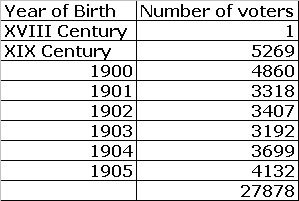
Besides this remarkable number of very old people, which should call for a team of experts from the WHO to come and study them, there is the peculiar person born in the XVIII th. Century which should be the subject of investigation on his/her own.
Besides this, there is the growth in the number of people registered to vote as well as migrated from one municipality to the other as seen in the table below:
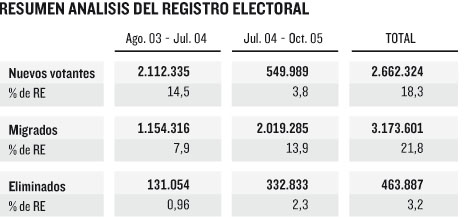
The number of new voters increased between August 03 and October 05 by 18.3% (and has reached 20% at the time of this writing). The Government explains this by saying that this is the result of a program to include people in the electoral process, however, the “inclusion” is highly non-uniform concentrating in the border states and Caracas. At the same time 21.8% of the voters have moved since August 2003, 13.9% since the recall vote which is quite surprising more so when you find out that an inordinate proportion compared to historical patterns is to a different state (20%) or a different electoral circuit (10%).
Wednesday, November 16, 2005
Monday, November 07, 2005
Sumate leaders charged and prohibited from leaving the country
Originally published here
Continuing in its attempt to intimidate and block the opposition just prior to the upcoming elections for the National Assembly, a Judge decided tonight to charge four of the Directors of Sumate for conspiracy against the Government. The charge comes form receiving funds from the National Endowment for Democracy for electoral education. Sumate has been a thorn in the Government's shoe as it activities allowed the opposition to gather the signatures to be able to call for the recall of Hugo Chavez. Sumate has unveiled all of the problems with the electoral process in Venezuela and its leaders have been going around the world presenting this document (in English here) about the State of Democracy in Venezuela. In contrast to the Government that uses State funds for party activities without accountability, Sumate has provided all of its financial information on the web, including contracts with funding agencies, as well as its financials.
This is simply another fascist act by the Government: find a way to criminalize the opposition activities in order to stop them and intimidate them. The Prosecutor handling the case is Prosecutor Luisa Ortega, who has taken over most of the responsibilities that Danilo Anderson used to have of handling political cases. Meanwhile, all accusations against the Government, including murders, abuse of power and corruption are simply shelved or "decided" by a Judiciary that is totally controlled by the Government.
Did I forget to say some people claim this is still a democracy?
Continuing in its attempt to intimidate and block the opposition just prior to the upcoming elections for the National Assembly, a Judge decided tonight to charge four of the Directors of Sumate for conspiracy against the Government. The charge comes form receiving funds from the National Endowment for Democracy for electoral education. Sumate has been a thorn in the Government's shoe as it activities allowed the opposition to gather the signatures to be able to call for the recall of Hugo Chavez. Sumate has unveiled all of the problems with the electoral process in Venezuela and its leaders have been going around the world presenting this document (in English here) about the State of Democracy in Venezuela. In contrast to the Government that uses State funds for party activities without accountability, Sumate has provided all of its financial information on the web, including contracts with funding agencies, as well as its financials.
This is simply another fascist act by the Government: find a way to criminalize the opposition activities in order to stop them and intimidate them. The Prosecutor handling the case is Prosecutor Luisa Ortega, who has taken over most of the responsibilities that Danilo Anderson used to have of handling political cases. Meanwhile, all accusations against the Government, including murders, abuse of power and corruption are simply shelved or "decided" by a Judiciary that is totally controlled by the Government.
Did I forget to say some people claim this is still a democracy?
Tuesday, October 04, 2005
Sumate presents report on impact of illegalities on Venezuelan regional elections
Originally published here
Sumate presented today its analysis of the impact of the CNE illegally allowing Chavez' MVR to field "unrelated" parties for the slate and nominal candidates in August's regional elections, the so called "morochas" or twins The full report can be found here.
As a remainder, Venezuelan legislation allows parties to field both nominal and slate candidates, but in order to preserve the rights of minority representation, guaranteed by the Constitution; the number of candidates elected under their own name is subtracted from the number of candidates elected under the slate. In the last election, Chavez' MVR registered an unknown new political party (UVE) to field nominal candidates, using MVR to field the slate, this was used to bypass the law, under the consenting approval of the Electoral Board. Opposition Governor Manuel Rosales of Zulia state did the same sneaky trick. This only works if you have a majority, as it allows you to grab more positions than the law would assign you.
What Sumate did was to assume that MVR and UVE were the same party and recalculate the number of candidates elected. The results are astonishing, not only did Chavez' party rip off the opposition, but it also fraudulently took a large number of positions from the minority parties that support Chavez himself!
Basically, Chavez' party MVR obtained 35.1% of the total vote, which according to the rules would have given them 42.8% of the seats up for grabs. However, the illegal use of the "morochas" or twins allowed Chavez' party to grab a total of 58% of all positions!
According to Sumate's analysis, minority parties that support Chavez obtained 19.4% of the votes, which entitled them to 14.4% of the seats, but because of the illegal and unfair advantage of Chavez' party they only got 9.3% of the total number of seats. The opposition on the other hand got 18.8% of the vote, which should have given them 21.6% of the seats, but because of the "morochas" was reduced to only 14.9%. Finally, local regional parties received 22.2% of the vote, which should have given them 18.6% of the positions, but only gave them 15.2% of the seats.
What is most remarkable about this analysis is that it was actually those that backed Chavez that were affected the most by the treachery. Minority parties that support Chavez saw their votes (19.4%) reduced to half the positions, despite the Constitutional guarantee for proportional representation. Some loyalty, no? In contrast opposition parties had their representation reduced by roughly 30% close to that of small local parties.
The details are remarkable. Basically, the Chavista trick gained them 363 additional positions, out of 584 total positions obtained by this unholy alliance called the "morochas" or twins. The same was true in Zulia state where Governor Rosales' "morochas" gave him 27 additional seats out of only 56 obtained. Shame on him too!
Some parties were absolutely ripped off by the trick. The infamous "Tupamaros" that have supported Chavez unequivocally during the last seven years, lost nine of the twelve seats they should have received, a staggering 75% of the total they would have obtained. With friends like Chavez, who needs enemies?
The analysis goes on in detail to show the level of abuse and illegalities committed by Chavez' majority with the unconditional and biased backing and help of the Consejo Nacional Electoral (CNE), which should not have only stopped the "morochas", but even allowed UVE to register past the deadline for registration of new parties and certified the signatures backing that party only six days before the regional elections took place. These guys are professional crooks!
These are the type of abuses that Chavez and his cronies are committing under the eyes of the world, that later allows them to claim this is a democracy. By eliminating the necessary checks and balances of any functional democracy, Chavez can not only use all of the resources of the State for the benefit of his own party, but can turn the rules and the law to his advantage without anyone saying or being capable of doing anything about it or even defending the rights of the "people" that are being violated by his actions as well as those of his party.
Sumate presented today its analysis of the impact of the CNE illegally allowing Chavez' MVR to field "unrelated" parties for the slate and nominal candidates in August's regional elections, the so called "morochas" or twins The full report can be found here.
As a remainder, Venezuelan legislation allows parties to field both nominal and slate candidates, but in order to preserve the rights of minority representation, guaranteed by the Constitution; the number of candidates elected under their own name is subtracted from the number of candidates elected under the slate. In the last election, Chavez' MVR registered an unknown new political party (UVE) to field nominal candidates, using MVR to field the slate, this was used to bypass the law, under the consenting approval of the Electoral Board. Opposition Governor Manuel Rosales of Zulia state did the same sneaky trick. This only works if you have a majority, as it allows you to grab more positions than the law would assign you.
What Sumate did was to assume that MVR and UVE were the same party and recalculate the number of candidates elected. The results are astonishing, not only did Chavez' party rip off the opposition, but it also fraudulently took a large number of positions from the minority parties that support Chavez himself!
Basically, Chavez' party MVR obtained 35.1% of the total vote, which according to the rules would have given them 42.8% of the seats up for grabs. However, the illegal use of the "morochas" or twins allowed Chavez' party to grab a total of 58% of all positions!
According to Sumate's analysis, minority parties that support Chavez obtained 19.4% of the votes, which entitled them to 14.4% of the seats, but because of the illegal and unfair advantage of Chavez' party they only got 9.3% of the total number of seats. The opposition on the other hand got 18.8% of the vote, which should have given them 21.6% of the seats, but because of the "morochas" was reduced to only 14.9%. Finally, local regional parties received 22.2% of the vote, which should have given them 18.6% of the positions, but only gave them 15.2% of the seats.
What is most remarkable about this analysis is that it was actually those that backed Chavez that were affected the most by the treachery. Minority parties that support Chavez saw their votes (19.4%) reduced to half the positions, despite the Constitutional guarantee for proportional representation. Some loyalty, no? In contrast opposition parties had their representation reduced by roughly 30% close to that of small local parties.
The details are remarkable. Basically, the Chavista trick gained them 363 additional positions, out of 584 total positions obtained by this unholy alliance called the "morochas" or twins. The same was true in Zulia state where Governor Rosales' "morochas" gave him 27 additional seats out of only 56 obtained. Shame on him too!
Some parties were absolutely ripped off by the trick. The infamous "Tupamaros" that have supported Chavez unequivocally during the last seven years, lost nine of the twelve seats they should have received, a staggering 75% of the total they would have obtained. With friends like Chavez, who needs enemies?
The analysis goes on in detail to show the level of abuse and illegalities committed by Chavez' majority with the unconditional and biased backing and help of the Consejo Nacional Electoral (CNE), which should not have only stopped the "morochas", but even allowed UVE to register past the deadline for registration of new parties and certified the signatures backing that party only six days before the regional elections took place. These guys are professional crooks!
These are the type of abuses that Chavez and his cronies are committing under the eyes of the world, that later allows them to claim this is a democracy. By eliminating the necessary checks and balances of any functional democracy, Chavez can not only use all of the resources of the State for the benefit of his own party, but can turn the rules and the law to his advantage without anyone saying or being capable of doing anything about it or even defending the rights of the "people" that are being violated by his actions as well as those of his party.
Friday, August 19, 2005
El estado de la Democracia en Venezuela
Originally published here and here
18.08.05 | Este documento presenta los hechos más relevantes relacionados con la evolución de la democracia en Venezuela durante la Presidencia de Hugo Chávez Frías, que comenzó en enero de 1999.
Los hechos están organizados alrededor de las dimensiones que definen una democracia:
1-. Independencia de los Poderes Públicos
2-. Respeto al Estado de Derecho
4-. Respeto a la Libertad de Expresión
5-. Respeto a los DDHH y otras Libertades Fundamentales
6-. Estado de las Instituciones
Para acceder a la documentación de soporte, solo haga click en el tema de su interés y siga las instrucciones, las cuales en algunos casos lo llevarán a leyes, resoluciones, artículos de prensa, videos u otros documentos relevantes.
Thursday, August 11, 2005
Chile: Senate's President meets with Sumate's director

Originally published here
The President of Chile's Senate Sergio Romero held a protocolar meeting with Alejandro Plaz founder of Sumate, NGO which promotes participatory democracy and defends political rights in Venezuela.
In the meeting, that lasted for about 20 minutes, Romero and Plaz shared impressions vis-a-vis the political situation of their respective countries.
Friday, August 05, 2005
Sumate: No Transparency in Venezuelan Electoral Registry
Originally published here by Miguel Octavio
Yesterday, Sumate introduced in the Electoral Board (CNE) a request that the Electoral Registry be published as established in the Law of Suffrage and Political Participation. This is one of those subtle points that need to be explained in detail, because it is part of the bag of tricks used by the Government to cheat and manipulate elections.
The law says the Registry has to be made public, In fact, the law says the Electoral Board will give a copy to all political parties "whenever they request it" (Article 95), as well as saying that every month it will have to notify and post publicly any additions or removals to the Registry. (Article 106). Last year, before the recall vote, Sumate also tried to get the registry published, to no avail. You see the registry not only contains the name and ID number of each voter, but also his/her address. Last year and this year, using personnel outside of the Office of Identification, the Government gave out ID cards and registered to vote over a million new voters. This supposedly "democratic" registration drive took place only after the opposition managed to get the required signatures to vote on a possible recall of Hugo Chavez as President.
Incredibly enough, in some municipalities there are now more voters than inhabitants a subject that I have discussed before in this blog more than one time. These type of anomalies and many more have led Sumate to make a number of request to the CNE and even to ask the Supreme Court for an injunction, which was rejected. If you have the patience you can read the decision here. Well, the Court used the old trick of using a critique of formal steps in order to not decide on the substance of the case. What is clear is that the law says the registry has to be published. It hasn't. Why?
The reason is obvious. Now more than ever those people registered last year are needed in the upcoming election. Last year Chavez needed sheer numbers, now his party needs the votes where it matters. We will be electing this Sunday, members for the City Councils of all of Venezuela. Chavistas need the votes where they don't have the Mayors to make the life of opposition Mayors really difficult. And they need to win handily where they have the Mayors to do as they please with municipal Treasuries.
Sumate, once again, is trying to use the law, asking the CNE directly to provide the Registry. This is called an administrative recourse. The CNE will obviously not hand it over, it would reveal what a farse elections are now in Venezuela. Thus, much like last year the CNE did not do the audit that had been agreed on the night of the recall vote, and refused to open all of the ballot boxes to count the votes manually, it will refuse to hand over the registry.
That is why Venezuela is no longer a real democracy. In a real democracy you need to have transparency. In a real democracy you have to follow the laws. There is no transparency in Venezuela with regards to the Electoral Board and its actions. The law was and is being violated on electoral matters. A few simple actions by the CNE would have revealed last year and this year whether there was something funny going on with the votes. The CNE refused, with the support of the Electoral Hall of the Supreme Court, to follow these simple steps. Even the most naive individual could not help but ask: Why? What do they have to hide?
Yesterday, Sumate introduced in the Electoral Board (CNE) a request that the Electoral Registry be published as established in the Law of Suffrage and Political Participation. This is one of those subtle points that need to be explained in detail, because it is part of the bag of tricks used by the Government to cheat and manipulate elections.
The law says the Registry has to be made public, In fact, the law says the Electoral Board will give a copy to all political parties "whenever they request it" (Article 95), as well as saying that every month it will have to notify and post publicly any additions or removals to the Registry. (Article 106). Last year, before the recall vote, Sumate also tried to get the registry published, to no avail. You see the registry not only contains the name and ID number of each voter, but also his/her address. Last year and this year, using personnel outside of the Office of Identification, the Government gave out ID cards and registered to vote over a million new voters. This supposedly "democratic" registration drive took place only after the opposition managed to get the required signatures to vote on a possible recall of Hugo Chavez as President.
Incredibly enough, in some municipalities there are now more voters than inhabitants a subject that I have discussed before in this blog more than one time. These type of anomalies and many more have led Sumate to make a number of request to the CNE and even to ask the Supreme Court for an injunction, which was rejected. If you have the patience you can read the decision here. Well, the Court used the old trick of using a critique of formal steps in order to not decide on the substance of the case. What is clear is that the law says the registry has to be published. It hasn't. Why?
The reason is obvious. Now more than ever those people registered last year are needed in the upcoming election. Last year Chavez needed sheer numbers, now his party needs the votes where it matters. We will be electing this Sunday, members for the City Councils of all of Venezuela. Chavistas need the votes where they don't have the Mayors to make the life of opposition Mayors really difficult. And they need to win handily where they have the Mayors to do as they please with municipal Treasuries.
Sumate, once again, is trying to use the law, asking the CNE directly to provide the Registry. This is called an administrative recourse. The CNE will obviously not hand it over, it would reveal what a farse elections are now in Venezuela. Thus, much like last year the CNE did not do the audit that had been agreed on the night of the recall vote, and refused to open all of the ballot boxes to count the votes manually, it will refuse to hand over the registry.
That is why Venezuela is no longer a real democracy. In a real democracy you need to have transparency. In a real democracy you have to follow the laws. There is no transparency in Venezuela with regards to the Electoral Board and its actions. The law was and is being violated on electoral matters. A few simple actions by the CNE would have revealed last year and this year whether there was something funny going on with the votes. The CNE refused, with the support of the Electoral Hall of the Supreme Court, to follow these simple steps. Even the most naive individual could not help but ask: Why? What do they have to hide?
Thursday, August 04, 2005
Friday, July 29, 2005
Prosecution of Sumate leaders in Venezuela: ABA's observer preliminary report
Originally published here
The complete report can be found here
The complete report can be found here
By Douglass Cassel | Center for International Human Rights
Editor's note: At the request of Mr. Robert D. Evans, Director of Governmental Affairs of the American Bar Association, I include this disclaimer: "The attached report was prepared by Professor Douglas Cassel for the American Bar Association following his observation of preliminary proceedings in the Sumate case. It has not been approved for release by the American Bar Association and therefore does not represent the views of the Association or any of its entities but only the personal views of Professor Cassel."
This preliminary report is presented by American Bar Association observer Douglass Cassel, following a visit to Venezuela during pretrial proceedings held on July 6 and 7, 2005, in case no. 41-C-4077-04 before the Fourth Court of Control of First Instance in the Criminal Judicial Circuit of the Metropolitan Area of Caracas.
Introduction
Venezuelan prosecutors have charged two leaders of a civic group for soliciting funds from the National Endowment for Democracy (“NED”) in Washington to educate voters about their right to participate in a referendum to recall Venezuelan President Hugo Chávez Frías. Two trainers who led voter education workshops are charged as accomplices. The recall referendum, held in August 2004, was unsuccessful.
The case is brought in a context of political polarization between Venezuela’s government and the opposition, and amid disputes between its government and the government of the United States and NED, a private, non-profit organization with an independent board of directors, but which by law receives annual funding from the US State Department.
As an independent professional organization dedicated to the rule of law, the American Bar Association takes no position on Venezuela’s internal political affairs. Nor does the ABA take a position on policy differences between the governments of Venezuela and the US, or on whether the NED grant in question was advisable as a matter of policy. The ABA’s sole concern is whether the proceedings in this case comport with international standards governing criminal prosecutions and rights of political participation, and the implications of this case for the rule of law and the exercise of internationally protected rights in Venezuela.
The civic group that solicited the NED grant is called Súmate (“Join up”). Venezuelan prosecutors appear to concede that, except for the solicitation of NED funds, Súmate’s educational and promotional activities relating to the referendum were lawful. However, they accuse Súmate’s President, Alejandro Plaz, and Vice President, María Corina Machado, of violating a law that imposes prison terms of 8 to 16 years on any Venezuelan who “solicits foreign intervention in the internal political affairs of Venezuela.”
In the opinion of this observer, both that law as applied in this case and the criminal proceedings to date fail to meet international standards.
First, as applied in a novel way in this case, the law is impermissibly vague. Although it dates from early in the last century, it apparently has never previously been used to prosecute foreign funding of otherwise lawful activity in Venezuela. Its meaning in this context is so unclear as to violate international standards requiring fair notice to defendants of what conduct is deemed criminal. How are Venezuelan citizens to know whether a civic group’s seeking foreign funding for lawful activities equates to soliciting “foreign intervention”?
Second, the ambiguities in the law should be resolved in a manner consistent with Venezuela’s international legal obligations. So interpreted, the law would not criminalize Súmate’s solicitation of NED funds. International law protects both the right to solicit funds to educate citizens about the exercise of fundamental rights, and the right to make effective the exercise of the vote in a referendum.
Third, the case is brought before a Venezuelan judiciary that fails to meet international standards of judicial independence. More than 80% of Venezuelan judges, including the pretrial judge in this case, are “provisional” judges. They have no tenure and can be removed by the Supreme Court at any time without explanation.
The Supreme Court likewise lacks structural independence. During 2004 it was expanded from 20 to 32 justices, and other justices were replaced, so that the overwhelming majority of justices are now considered pro-Chávez. And their appointments may be suspended or annulled based on such subjective standards as omitting “true facts” from their opinions or bringing the judiciary into “disrespect.”
The vulnerability of the judiciary to outside influence is of particular concern in the politicized context of this case. Not only did Súmate promote a referendum to recall the President, but the President publicly accused Súmate leaders of committing crimes by soliciting NED funds. The prosecution began soon thereafter and has continued during public, mutual recriminations between Venezuelan authorities and NED.
Fourth, certain aspects of the pretrial proceedings to date violate due process of law. For example, even though Súmate leaders were the targets of the preliminary criminal inquiry, the prosecutor initially accorded them rights only as witnesses rather than as suspects. However, it is not yet clear whether these violations will ultimately be prejudicial at trial.
On the other hand, Venezuelan courts have protected the rights of the accused to remain at liberty pending trial. The Supreme Court ruled in November 2004 that they should not be incarcerated pending trial. In July 2005 the pretrial judge again refused the prosecutor’s request that they be jailed pending trial.
Despite these laudable rulings, the proceedings overall fail to meet international standards of the rule of law. Súmate leaders are being prosecuted in a highly charged political atmosphere under an impermissibly vague law, interpreted in a manner inconsistent with their internationally protected rights, before a judiciary that lacks independence and has already violated certain of their due process rights.
Moreover, during a pretrial hearing on July 6, 2005, the prosecutor warned that additional persons may be charged, and that further charges may be brought against Súmate leaders. Internationally respected human rights lawyers in Venezuela expressed concern to the observer that the prosecution of Súmate could have a chilling effect on the exercise of political rights, and that it is part of a broader pattern of persecution of groups opposed to President Chávez.
At the conclusion of that hearing on July 7, 2005, the pretrial judge overruled defense motions to dismiss and ordered that the case against all four defendants proceed to trial. Although the timing is uncertain, the trial could begin as early as August 2005.
The European Union has reportedly decided to send an observer if the case is taken to trial. For the reasons discussed in part 10 below, the ABA should likewise send an observer to the trial. An ABA decision on further action, if any, can and should await the observer’s final report.
Wednesday, July 27, 2005
No more "secret" voting in Venezuela?
Original for this site
One of the criticism made by the Venezuelan electoral board, CNE, is that additional "electronic automatization" is directly endangering the secret of the vote at the polling station. Indeed, now the CNE pretends us to check in first through a lap top that contains the voter registry. That is, from now on the voter will be electronically registered for name AND ARRIVAL TIME. Since the voter will stand in line right then, in the same sequence as s/he arrived at the polling station, it will be very easy to "arrange" the internal registry of the electronic machines to figure out who voted for who. Sumate has made an active web page which shows clearly how the system would work.
This page is in Spanish but with the explanations given above, the non Spanish reader will figure out clearly how the system functions to detect who casts what vote.
There has been enough of an outcry from the part of Sumate that the CNE has announced that the system will be "tested" in only two states for the coming August 7 election. But it is EXTREMELY clear that the Venezuelan system could be rigged for more important elections, such as the parliamentarian of December 2005 or the presidential of December 2006, the ones that Chavez really cares about.
However what is even worse than any eventual cheating by the CNE is that people will be scared. Afraid of losing any social benefit, afraid of receiving any unjust sanction (see the infamous Tascon list with the names of all those who signed against Chavez in August 2004), many opponents of the regime will prefer either to abstain from voting, or feel forced to vote for Chavez. Even if eventually the system is ditched there will be a significant amount of people that will be dubious for quite a while. But then again this is the intention of the regime, isn´t it?
Thus the much vaunted 1999 constitution, allegedlychockfulll of civil rights, is seeing all these rights taken away one by one. The right to call for a recall election has disappeared when people saw that their name was taken by the government and used against them. The right of secret voting seems on the way out. The right to justice has been taken away last year by packing the High Court by Chavez hacks. Etc, etc...
One of the criticism made by the Venezuelan electoral board, CNE, is that additional "electronic automatization" is directly endangering the secret of the vote at the polling station. Indeed, now the CNE pretends us to check in first through a lap top that contains the voter registry. That is, from now on the voter will be electronically registered for name AND ARRIVAL TIME. Since the voter will stand in line right then, in the same sequence as s/he arrived at the polling station, it will be very easy to "arrange" the internal registry of the electronic machines to figure out who voted for who. Sumate has made an active web page which shows clearly how the system would work.
This page is in Spanish but with the explanations given above, the non Spanish reader will figure out clearly how the system functions to detect who casts what vote.
There has been enough of an outcry from the part of Sumate that the CNE has announced that the system will be "tested" in only two states for the coming August 7 election. But it is EXTREMELY clear that the Venezuelan system could be rigged for more important elections, such as the parliamentarian of December 2005 or the presidential of December 2006, the ones that Chavez really cares about.
However what is even worse than any eventual cheating by the CNE is that people will be scared. Afraid of losing any social benefit, afraid of receiving any unjust sanction (see the infamous Tascon list with the names of all those who signed against Chavez in August 2004), many opponents of the regime will prefer either to abstain from voting, or feel forced to vote for Chavez. Even if eventually the system is ditched there will be a significant amount of people that will be dubious for quite a while. But then again this is the intention of the regime, isn´t it?
Thus the much vaunted 1999 constitution, allegedlychockfulll of civil rights, is seeing all these rights taken away one by one. The right to call for a recall election has disappeared when people saw that their name was taken by the government and used against them. The right of secret voting seems on the way out. The right to justice has been taken away last year by packing the High Court by Chavez hacks. Etc, etc...
Monday, July 18, 2005
Delenda Sumate!
Originally published here
“Delenda Carthago!”.
It meant, that, no matter what,
Publicity is always effective. In the end, Cato’s message was heard and
It was a tough and dirty war, even for those times,
After three bloody years of continuous fights,
Ironically,
After reading this fascinating story, I thought of the similarities between the Sumate persecution by the Chavez government and the insistence of Cato to destroy
Chavez was a military man and it is still today a military man. In his quest towards absolute power, he has been treating Venezuelan institutions as if they were “the enemy”. An enemy that had to be controlled and beaten.
He has been extremely successful.
His success is due in part to the clumsy and inefficient opposition, in part because nobody believed that he could go that far and still pretend that he was a democratic ruler. Finally and foremost, because
No matter the reason of Chavez’s success, there was a new type of enemy in town that Chavez was not used to fight: Sumate.
The origin of Sumate is, to say the least, unusual. In a country where the civil society was not used to have its voice heard, suddenly there was a civil group that organized itself to literally prevent a civil war in
It was an exit that any democratic leader would have welcome: a recall Referendum, guaranteed in the 1999 Constitution; let the people decide.
But Chavez government was not happy at all about it and did all the possible tricks to avoid going to a Referendum. Sumate organized a signature collection, not once, but three times! (see Daniel’s excellent summary here). They were systematic and efficient and used Chavez’s own weapon: the 1999 Chavista Constitution to lead the fight.
A few months before the Referendum took place, Sumate persecution started. It was Chavez itself who, like Cato in the Senate, initiated it by talking in his Sunday TV program about the NED funding. But the Chavista government is, in matters of political persecution, much more effective than the Roman government. It did not take years to initiate the “Delenda Sumate” campaign. The very next day, the Sumate directive was charged by the government attorneys.
I do not think that the funding was illegal. The money was a small grant to organize courses to promote democratic awareness. However, if the money had indeed been illegal, then the government should have fined Sumate and asked them to reimburse it. End of it.
But, according to Chavez, Sumate delenda est! The government had to put all its weight and influence to discredit Sumate and to take its directive to court for …no less than treason!
They dusted a very old article of the very archaic Venezuelan penal code to state that Sumate was destroying “the Republican form” of the government. Thanks to a convoluted interpretation that nobody in his right mind would accept, receiving the small grant from the NED resulted in being charged for treason and risking up to 16 years in jail.
And, by the way, we are talking about Venezuelan prisons.
The attack was not directed towards the institution. It was personally aimed at the four highest members of Sumate: Maria Corina Machado, Alejandro Plaz, Ricardo Estevez and Luis Enrique Palacios. The four young engineers that had dared to create a new form of resistance in
Delenda Sumate!
Meanwhile, since the Referendum, the mighty Chavez government has been taking over whatever was left of the democratic institutions of the country. In particular, the judiciary system, that has never been a model of independence, has been revamped to have only judges blindly committed to Chavez. I hope that Sumate is cleared, but the hope is closer to wishful thinking.
So, there is a high probability that, in the end, Sumate will be destroyed, and that the Chavez goverment will have thrown salt to the Sumate office created by a small group of unlikely democratic heroes.
Maybe, like some historians suspected, Chavez, like Cato, is using Sumate as a diversion. Maybe he is really committed to attack this new type of enemy that resists his controlling expansion or maybe he just do not know how to govern without having an enemy in front of him. In any case, it is clear that Chavez has not learned the lessons from Rome.The Romans flourished while they incorporated the good features of the foreign cultures into their own. The anhilation of
Chavez has not realized that his enemy is not Sumate. His enemy, like in
He can ask his followers to “Delenda Sumate” as much as he wants and like the Romans, he might win the last Punic war.
Thursday, July 14, 2005
Sumate: the CNE has not fulfilled audit of the electoral registry, nor has it cleaned up electoral rolls
From Union Radio.
María Corina Machado, integrante de la organización civil Súmate, reiteró que continúan los esfuerzos que adelantan con la campaña para impugnar el Registro Electoral venezolano. Asimismo recordó que el Consejo Nacional Electoral se habría comprometido a realizar una auditoría pública para depurar el REP y no ha cumplido.
"Los casos de Rodrigo Granda y El Chigüiro (ambos ciudadanos colombianos) fueron los más emblemáticos, pero hay miles de denuncias. Estas son personas de otra nacionalidad pero que están inscritas en el REP y votaron en el referéndum. Esto hizo tanta presión que el CNE se comprometió públicamente hacer una auditoría pública externa y la depuración del mismo (...) y en vez de cumplir su palabra de una auditoría pública pues contrata a Capel para una asistencia técnica al propio CNE".
Según Machado, entre los puntos de acuerdo llegados por el Consejo Nacional Electoral y la empresa Capel, ésta tendría prohibido entregar los resultados de las elecciones a ninguna otra organización que no sea el CNE, "ni siquiera en los términos de referencia está autorizado a dárselos a otro ente, nosotros hemos tenido reuniones y ellos han sido receptivos pero no tenemos idea de lo que efectivamente Capel va a hacer".
Respecto a la decisión del Poder Electoral de utilizar los cuadernos electrónicos sólo en los estados Nueva Esparta y Cojedes, Machado manifestó que es inaceptable, pues en su criterio ello será una excusa para obligar el uso de los mismos en las elecciones de diputados fijadas para el venidero mes de diciembre.
Expresó que durante el encuentro con la delegación de la Organización de Estados Americanos OEA que visita nuestro país, Súmate entregó sus últimos sobre el estado del Registro Electoral así como las violaciones a la ley del sufragio cometidas por parte del CNE.
María Corina Machado, integrante de la organización civil Súmate, reiteró que continúan los esfuerzos que adelantan con la campaña para impugnar el Registro Electoral venezolano. Asimismo recordó que el Consejo Nacional Electoral se habría comprometido a realizar una auditoría pública para depurar el REP y no ha cumplido.
"Los casos de Rodrigo Granda y El Chigüiro (ambos ciudadanos colombianos) fueron los más emblemáticos, pero hay miles de denuncias. Estas son personas de otra nacionalidad pero que están inscritas en el REP y votaron en el referéndum. Esto hizo tanta presión que el CNE se comprometió públicamente hacer una auditoría pública externa y la depuración del mismo (...) y en vez de cumplir su palabra de una auditoría pública pues contrata a Capel para una asistencia técnica al propio CNE".
Según Machado, entre los puntos de acuerdo llegados por el Consejo Nacional Electoral y la empresa Capel, ésta tendría prohibido entregar los resultados de las elecciones a ninguna otra organización que no sea el CNE, "ni siquiera en los términos de referencia está autorizado a dárselos a otro ente, nosotros hemos tenido reuniones y ellos han sido receptivos pero no tenemos idea de lo que efectivamente Capel va a hacer".
Respecto a la decisión del Poder Electoral de utilizar los cuadernos electrónicos sólo en los estados Nueva Esparta y Cojedes, Machado manifestó que es inaceptable, pues en su criterio ello será una excusa para obligar el uso de los mismos en las elecciones de diputados fijadas para el venidero mes de diciembre.
Expresó que durante el encuentro con la delegación de la Organización de Estados Americanos OEA que visita nuestro país, Súmate entregó sus últimos sobre el estado del Registro Electoral así como las violaciones a la ley del sufragio cometidas por parte del CNE.
Monday, July 11, 2005
The SUMATE summary
Originally published here
The trial of Sumate has started. It is important to summarize why this trial is a travesty of justice, a political vendetta under any angle that one might look at it. And, even if Sumate had committed an electoral crime, that supposed crime would pale in comparison to all the electoral crimes committed by the Chavez administration since the year 2000.
Now that I have given an early conclusion to this post, I can go into the details. First a brief history of Sumate and then a comparative table of the charges brought against Sumate and the government own electoral misdeeds. The reader will be able to decide on its own which one of the two should sit on the accused bench.
Brief Historical
SUMATE is a civil society organization, an NGO, which started as a group of young professionals seeking to help citizens demand their right to clean and fair elections. Already the Carter Center itself declared the 2000 elections flawed (though it seems to have forgotten its own words of 2000 in August 2004). The nature of the political process in Venezuela where the chavista legal steam roller started crushing any opposition attempt at obtaining redress through the ballot box made Sumate associated with the opposition parties, though some of its services could have been used by both sides.
Sumate was established sometime mid 2002 as the organization to manage the first signature gathering petition to take place. This one was the Consultative Referendum who gathered with a speed that surprised both opposition and government more than the 10% necessary for a consultative referendum as to whether Chavez should resign from office. That initiative which was received by the Electoral Board of Venezuela, CNE, under a rain of tear gas in November 2002, never prospered since by a legal trick it was declared non acceptable. However we shall see that the people who signed that supposedly illegal drive would suffer its consequences anyway.
The success of Sumate then made it the one coordinating the effort for the firmazo, that February 2003 signature drive that collected without any problem the 20% needed to ask for a Recall Election on Chavez. Again, thanks to legal tricks and the complacency of the Carter Center and OAS (and myopia of the opposition leadership) that collection was annulled. And again those who signed would still be punished for that exercise of their civil right to petition.
Once the agreement of June 2003 where signed, Sumate was again called to service to coordinate the December final petition drive to call for a Recall Election. But then things had become more complicated as the government had shown its true undemocratic color as it threatened to make good use of the fact that the names of the people that would sign would be known, made public. For example the Significant Other of this blogger, a public employee in a ministry, and fervent anti Chavez, decided not to sign that petition, with the agreement of this blogger who did sign as less subject to prosecution. Thus the beginning of the rendering of families and friends who many times could not understand why some did or did not sign.
But the Chavez administration came up with even more tricks (in spite of the now infamous "no tricks" of ex-president Carter). A large amount of signatures were declared void on shaky grounds and Sumate again had to show its efficiency by organizing a "repair" process that was successful in spite of now an outright frontal attack from the government. By then the people knew that the Chavez administration had established a list of people who had signed in all the previous signature collection. That list, embodied in one of its incarnations as the Tascon list from assemblyman Luis Tascon web page where one could check out anyone's ID number to see if that person had signed "against Chavez" was used to fire public employees and deny services from the state such as passports and ID card emission, or filter who would get a contract or a job for governmental work. Truly, a new apartheid that is still in application today as I write, and which is well documented for the fascist list it is and that is been decried overseas more and more.
But now Sumate was itself under attack as the government claimed that it had illegally received funds from the National Endowment for Democracy, NED. First the accusation is shaky even on Venezuelan legal grounds. Second the NED finances all sorts of NGO, even in Venezuela (curiously Sumate is the only one prosecuted...). And third it does not make any mystery of it, being a congressional organization which is controlled in a bipartisan manner by the US Congress. Sumate has on one of its web page the copy of the NED agreement if anyone cares to read it. As early as November 4th, The Economist was writing that under the manipulated Venezuelan judicial system, a Sumate trial could only be seen as a political prosecution. The Economist is only one of the many folks making the easy connection.
The trial that is opening against 4 of Sumate's directors has been maturing for over a year as it has been difficult for the government to make a case. First, on a public relations front, the hoped for departure to exile of Sumate's leaders has not happened as they have courageously not only stayed in Venezuela, but even left for short trips and came back each time. Second Maria Corina Machado has been received at the White House by President Bush, the only Venezuelan figure that has been received at the White House since Chavez came to office in 1998.
Summary of the charges
(1) It is fair to note that as an OPEC member Venezuela requires to have relations with Iran, Iraq and Libya. What is also fair to say is that the effusiveness of Chavez when he visited those countries and leaders was excessive, totally uncalled for and unnecessary, in particular the Baghdad junket where the car ride with Saddam driving was just too much.
But even if the charges were valid, let's not forget that the NED money was a drop in the bucket of all what the opposition received for its electoral campaigns, and even less of a drop when it is compared to the floods of public monies used by chavismo to secure the the vote for its leader. Hypocrisy!
Conclusion
There should be no doubt in the reader's mind that the only reason why Sumate is prosecuted is that it is at the heart of any opposition electoral organization. Its efficiency, its unquestionable message of free and fair election in front of the pathetic and shifty figure of the CNE through its most discredited president, Rodriguez, is something that chavismo and Chavez cannot forgive, nor forget. Sumate, in fact, is by contrast the constant reminder of all that is wrong with the Chavez administration, its inefficiency, the lackadaisical attitude of nearly all of its members, its moral corruption.
The reactions to the trial have already been numerous. The Sate Department condemned the prosecution in unambiguous terms. Human Rights Watch writes: “The court has given the government a green light to persecute its opponents,” said José Miguel Vivanco, Americas director at Human Rights Watch. “Prosecuting people for treason when they engage in legitimate electoral activities is utterly absurd.”
There is no need to add anything by this blogger as he is sure that international condemnation will keep coming from all quarters as chavismo takes a gamble on Sumate, a gamble that it will probably pay dearly.
The trial of Sumate has started. It is important to summarize why this trial is a travesty of justice, a political vendetta under any angle that one might look at it. And, even if Sumate had committed an electoral crime, that supposed crime would pale in comparison to all the electoral crimes committed by the Chavez administration since the year 2000.
Now that I have given an early conclusion to this post, I can go into the details. First a brief history of Sumate and then a comparative table of the charges brought against Sumate and the government own electoral misdeeds. The reader will be able to decide on its own which one of the two should sit on the accused bench.
Brief Historical
SUMATE is a civil society organization, an NGO, which started as a group of young professionals seeking to help citizens demand their right to clean and fair elections. Already the Carter Center itself declared the 2000 elections flawed (though it seems to have forgotten its own words of 2000 in August 2004). The nature of the political process in Venezuela where the chavista legal steam roller started crushing any opposition attempt at obtaining redress through the ballot box made Sumate associated with the opposition parties, though some of its services could have been used by both sides.
Sumate was established sometime mid 2002 as the organization to manage the first signature gathering petition to take place. This one was the Consultative Referendum who gathered with a speed that surprised both opposition and government more than the 10% necessary for a consultative referendum as to whether Chavez should resign from office. That initiative which was received by the Electoral Board of Venezuela, CNE, under a rain of tear gas in November 2002, never prospered since by a legal trick it was declared non acceptable. However we shall see that the people who signed that supposedly illegal drive would suffer its consequences anyway.
The success of Sumate then made it the one coordinating the effort for the firmazo, that February 2003 signature drive that collected without any problem the 20% needed to ask for a Recall Election on Chavez. Again, thanks to legal tricks and the complacency of the Carter Center and OAS (and myopia of the opposition leadership) that collection was annulled. And again those who signed would still be punished for that exercise of their civil right to petition.
Once the agreement of June 2003 where signed, Sumate was again called to service to coordinate the December final petition drive to call for a Recall Election. But then things had become more complicated as the government had shown its true undemocratic color as it threatened to make good use of the fact that the names of the people that would sign would be known, made public. For example the Significant Other of this blogger, a public employee in a ministry, and fervent anti Chavez, decided not to sign that petition, with the agreement of this blogger who did sign as less subject to prosecution. Thus the beginning of the rendering of families and friends who many times could not understand why some did or did not sign.
But the Chavez administration came up with even more tricks (in spite of the now infamous "no tricks" of ex-president Carter). A large amount of signatures were declared void on shaky grounds and Sumate again had to show its efficiency by organizing a "repair" process that was successful in spite of now an outright frontal attack from the government. By then the people knew that the Chavez administration had established a list of people who had signed in all the previous signature collection. That list, embodied in one of its incarnations as the Tascon list from assemblyman Luis Tascon web page where one could check out anyone's ID number to see if that person had signed "against Chavez" was used to fire public employees and deny services from the state such as passports and ID card emission, or filter who would get a contract or a job for governmental work. Truly, a new apartheid that is still in application today as I write, and which is well documented for the fascist list it is and that is been decried overseas more and more.
But now Sumate was itself under attack as the government claimed that it had illegally received funds from the National Endowment for Democracy, NED. First the accusation is shaky even on Venezuelan legal grounds. Second the NED finances all sorts of NGO, even in Venezuela (curiously Sumate is the only one prosecuted...). And third it does not make any mystery of it, being a congressional organization which is controlled in a bipartisan manner by the US Congress. Sumate has on one of its web page the copy of the NED agreement if anyone cares to read it. As early as November 4th, The Economist was writing that under the manipulated Venezuelan judicial system, a Sumate trial could only be seen as a political prosecution. The Economist is only one of the many folks making the easy connection.
The trial that is opening against 4 of Sumate's directors has been maturing for over a year as it has been difficult for the government to make a case. First, on a public relations front, the hoped for departure to exile of Sumate's leaders has not happened as they have courageously not only stayed in Venezuela, but even left for short trips and came back each time. Second Maria Corina Machado has been received at the White House by President Bush, the only Venezuelan figure that has been received at the White House since Chavez came to office in 1998.
Summary of the charges
| What Sumate is, does, represents... | What chavismo is, does, represent... |
| Is an NGO who organizes efficiently some of the electoral needs of the opposition parties | All rely on chavismo hold on the government levers, such as the CNE and the effect of the executive power to manage any electoral campaign |
| Has accepted a 51 000 USD grant from the NED | Has accepted millions from foreign companies such as the yet unsolved Bilbao Viscaya Bank 1998 campaign contribution |
| Has accepted a small grant which was used on voter education as to the agreement with the NED | Since 2000, uses all the power of the state and its monies to finance its electoral campaigns, without any check from any Venezuelan institution |
| Is efficient | Is a mess, success based slowly on Chavez charisma and the grants he spreads around to buy votes when needed |
| Stands trial as of last week | Walks freely as all the accusations of electoral fraud are blocked from even the most elemental investigation |
| Has accepted foreign money | Has accepted so much help from Cuba as to electoral tactics and organization that it is a joke |
| Maria Corina Machado has been received by George Bush | Chavez is not only received constantly by Castro, who he supports financially, but has been received by Saddam, Qaddafy and the Iranian Mullas (1) |
| Sumate wants a clear electoral register | The Chavez subservient CNE has Colombian guerillas voting in Venezuelan elections |
| Sumate wants a clear electoral register | The electoral registry is not only a mess but the CNE does not want to give it to the political parties for them to be able to organize their electoral targets (which chavismo does, by the way) |
And much more I could keep writing along these lines, but I am sure the reader is getting the point already | |
(1) It is fair to note that as an OPEC member Venezuela requires to have relations with Iran, Iraq and Libya. What is also fair to say is that the effusiveness of Chavez when he visited those countries and leaders was excessive, totally uncalled for and unnecessary, in particular the Baghdad junket where the car ride with Saddam driving was just too much.
But even if the charges were valid, let's not forget that the NED money was a drop in the bucket of all what the opposition received for its electoral campaigns, and even less of a drop when it is compared to the floods of public monies used by chavismo to secure the the vote for its leader. Hypocrisy!
Conclusion
There should be no doubt in the reader's mind that the only reason why Sumate is prosecuted is that it is at the heart of any opposition electoral organization. Its efficiency, its unquestionable message of free and fair election in front of the pathetic and shifty figure of the CNE through its most discredited president, Rodriguez, is something that chavismo and Chavez cannot forgive, nor forget. Sumate, in fact, is by contrast the constant reminder of all that is wrong with the Chavez administration, its inefficiency, the lackadaisical attitude of nearly all of its members, its moral corruption.
The reactions to the trial have already been numerous. The Sate Department condemned the prosecution in unambiguous terms. Human Rights Watch writes: “The court has given the government a green light to persecute its opponents,” said José Miguel Vivanco, Americas director at Human Rights Watch. “Prosecuting people for treason when they engage in legitimate electoral activities is utterly absurd.”
There is no need to add anything by this blogger as he is sure that international condemnation will keep coming from all quarters as chavismo takes a gamble on Sumate, a gamble that it will probably pay dearly.
Subscribe to:
Posts (Atom)